\
A Barcelona studio built on curiosity
From large-scale painting to intimate sketches: how reinvention fuels Sebastian Curi's family-driven practice
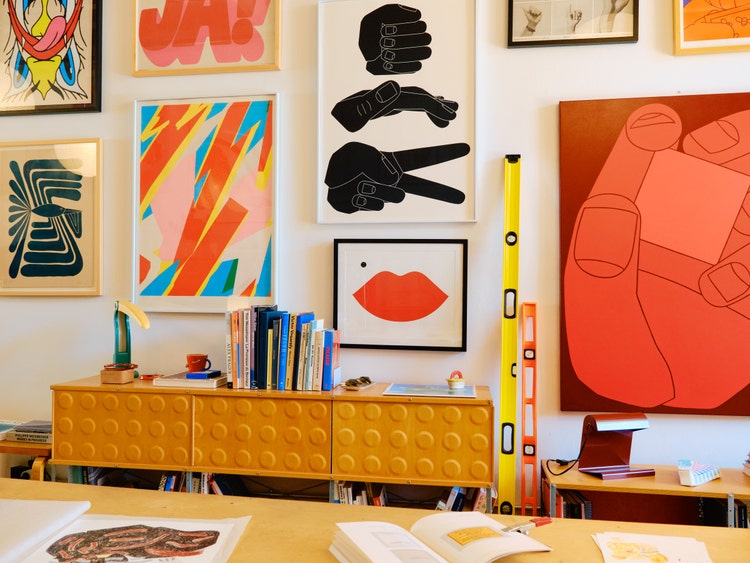
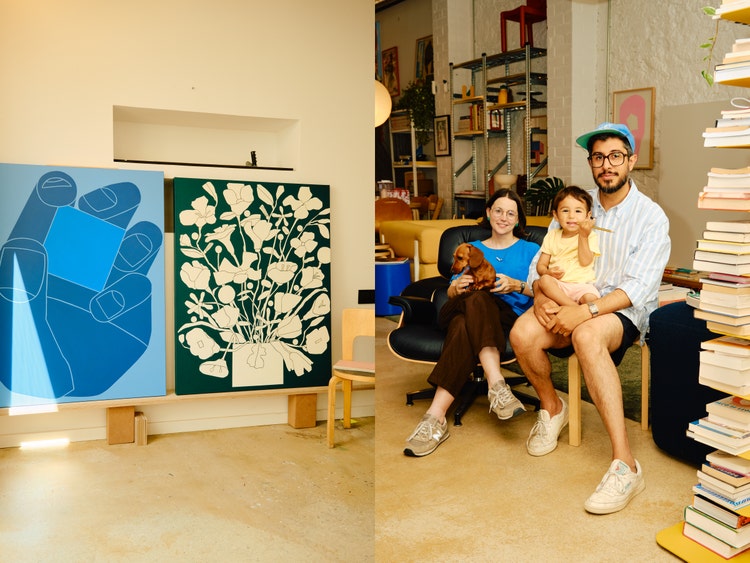
Stepping into the art-filled studio immediately transports visitors on a journey across mediums. First, you'll notice the larger-than-life handprints; Seb's signature drawings were born as an intimate "cleansing project" to decompress from commercial work, before they became popular among his Instagram followers. Then, you may spot their vintage etching press, humming throughout the day, while the big oak worktables are scattered with papers and sketch books or playful ceramic shoes—a recent craft experiment from Macarena—on a pile of design books. You may even spot a little wiener dog, Punchy, who often keeps company with the couple's young daughter Oli, frequently seen drawing on Seb's lap.
Sebastian, Seb to friends, first became known for his bold, colorful shapes and character illustrations, often with disproportionately small heads and long legs, which blend digital and tactile work. He’s also made a name with his viral drawings over photos, and immersive colorful murals for brands such as Starbucks, Chiquita, Google, as well as a celebrated cover for The New York Times kids section depicting one of his signature hand illustrations. But after speaking with Seb, even briefly, what becomes clear is that the client list isn't the point. What has always driven the studio is curiosity and exploration: a desire to keep playing, reinventing, before things turn formulaic. Here, boredom is always the enemy.
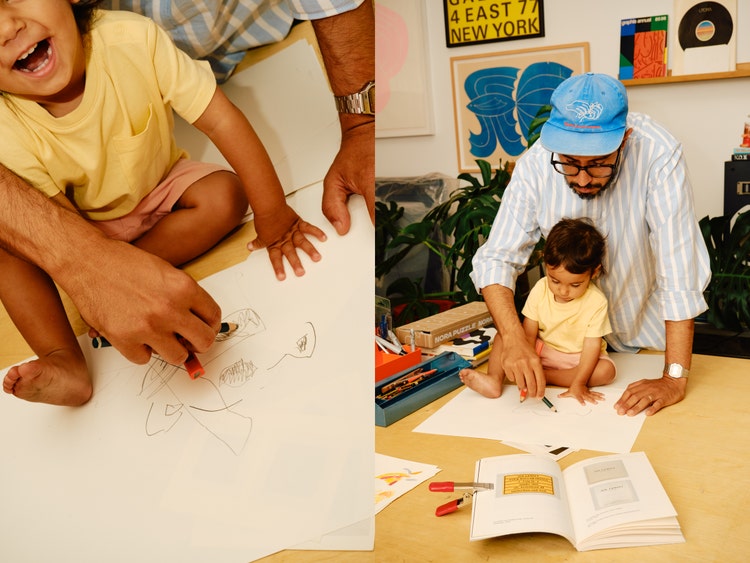
When the private project becomes the expected deliverable
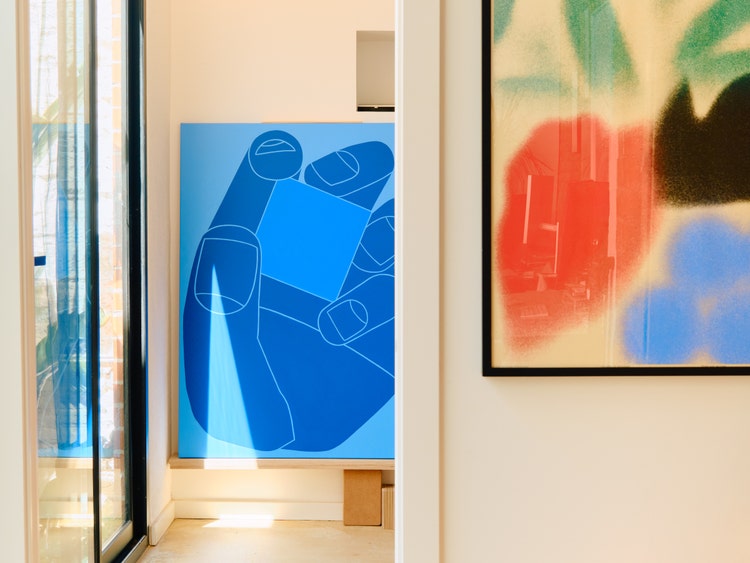
Seb's hand drawings are the clearest example of what happens when the thing you made to escape boredom becomes the thing everyone comes to expect. The pieces began as something just for himself—a way to step outside commercial work, which he would occasionally post to Instagram next to his commercial animation and illustration work, and for some time, no one quite knew what to make of it.
That changed as his homespun popularity grew, and what began as a private project has become, in his words, something “people now expect on a regular rhythm.”
“Now that it’s expected, it doesn't feel intimate like before," he tells us, with some resignation. But a new spark comes from conceptualizing how to keep something “honest” once it’s become commercial, which is, by his own account, still unresolved, but also part of why the studio keeps reaching for new mediums.
Learning in public, one print at a time
Curiosity is most visible in the couple's recent move into printmaking, woodwork, and ceramics—a medium in which neither is formally trained. Without this reference point, the staid fundamentals other artisans might take for granted still feel new.
"Because we didn't have formal training, things that look boring for someone with a fine arts background—for us, they're amazing. It's also a family thing. Because we work together, it's a different process. It sometimes takes longer. It's tedious. It can be frustrating. It's like, 'Oh, we messed with this paper; we should have used another one.' All that trial and error, I think there's beauty in that, and in what we learn from it,” says Macarena.
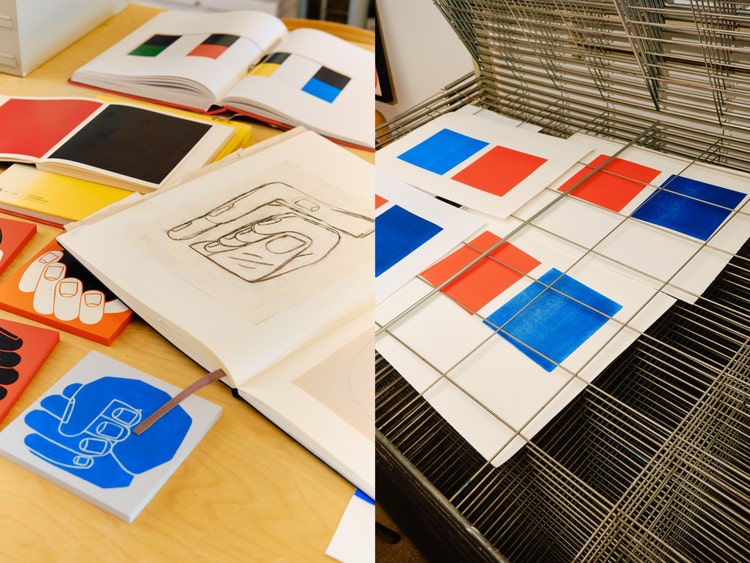
Part of what made this new learning curve workable is Barcelona itself. Here, Europe's printing tradition runs deep, and unlike Los Angeles, California, where this kind of craft work is niche, specialists who've spent years perfecting it aren't hard to find. With that, Seb and Macarena have been able to collaborate with local artists in person, teaching practices no online tutorial could. This process is often slower, and means handing over some control, but it's also how "works on paper"—the genre they’re leaning into with the space between painting and print, informal, and a little funky—keeps expanding into new territory: a first wooden bench, ceramic shoes, and now, whatever’s next.
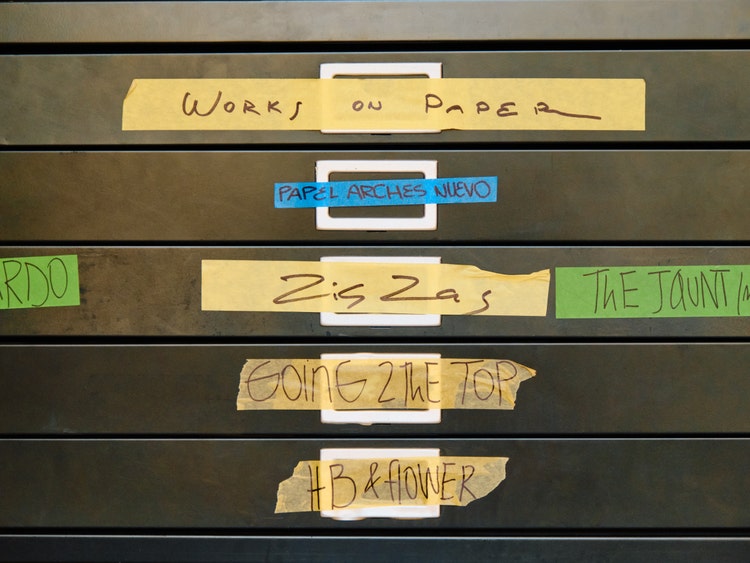
But this expansiveness is baked into their lives and practice. Making friends, exploring uncharted mediums and imagining far flung possibilities, is what led them, years earlier in their first creative home in LA, to move from animation to illustration, then later painting, and then to buy their first press, a Takach for etching, which they bought from a retiring printer just outside downtown LA, and got to work.
"Painting felt like being able to put ideas into a bigger form," Seb says of that earlier shift, from working mainly in digital and on small screens toward analog and works on print. The space itself has always shaped what they reached for, with a big table and printing materials in their LA studio helping crystallize work that had been gathering as a pastiche of ideas for years. Scale followed naturally, leading to the kind of larger wall prints he's now known (and commissioned) for. "The place you are in informs the work that you do," he says. "Before the table, we didn't have any analog work of that size. It's that literal."
In their current Barcelona studio, the couple often move between illustration, collage, painting, silkscreen and relief prints, and, most recently, woodwork—sometimes on the same day—as they’re drawn to tactile work and a process that forces slowing down and stepping away from the screen. But digital is core, with Instagram still essential to having Seb’s work be seen. There's still plenty of computer time, but mostly to document and amplify: from studio photos to candid looks at their process and experimentation.
A non-linear process
Nothing happened in a straight line. Originally from Argentina, Seb and Macarena moved to the US for corporate work early in their careers—Seb in animation, graphic design, and advertising and Macarena as a chef. After a few years, they felt disconnected and disillusioned, leaving their jobs to relocate to Vancouver, Canada, where they rented a small attic to rediscover their craft; there, Seb picked up illustration, while Macarena began experimenting with textiles and tufting, the pair finding they loved working alongside each other, sharing lunches, inspirations, and delving into their process and experiments.
While visiting Barcelona in 2013 for OFFF Festival, they fell in love with the city and its rich history of craft, and in 2025, when Seb and Macarena welcomed their first child, they decided to move, packing their belongings into shipping containers and making the Catalonian capital their home. Since then, the studio has become a melting pot between family life and artistic expression, and an open door to the design community. The pair often invite studio visits, host workshops, and offer mentorship opportunities for younger creatives on how to build something both joyful and financially sustainable.
Building a shared practice as a family
For their next chapter, Seb and Macarena are leaning further into the studio as a shared practice, building a joint exhibition for a small art gallery named “And Friends” in Santa Cruz, California, showcasing Seb’s illustration and Macarena’s collage pieces and bringing them into formal conversation for the first time. "We’re trying to compile our work and understand what could be fun as a family. Trying to make it together, make it sustainable, and find a way for both of us to do our thing. We always try to think as a team. We also share a life, a kid, our studio—it's all connected and intertwined. It's a big pile of things.”
And this “pile” is a fitting metaphor for where Seb and Macarena are at this moment. They’re building something new, together, one piece at a time, leaning into Seb’s belief that you need to keep exploring to stay engaged and the work will find its way again—sometimes it takes time and, maybe, a little cross-pollination of artistic mediums.