A practice without deliverables
What yoga taught me about being a designer
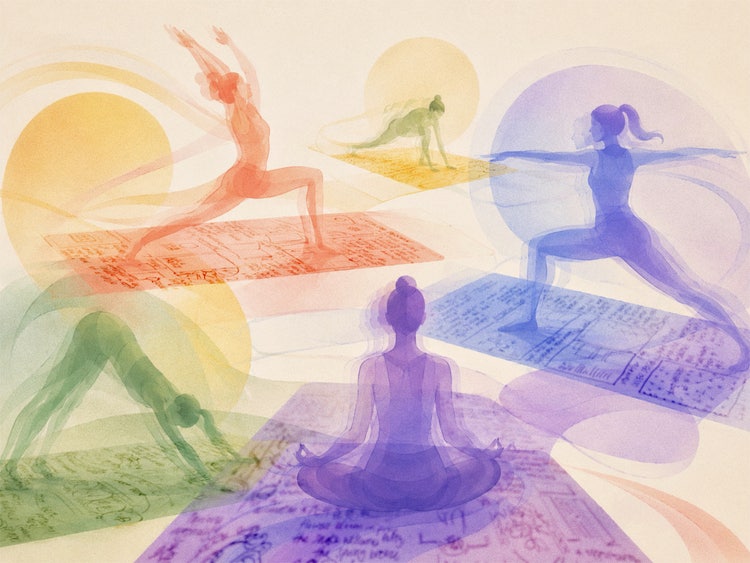
But in a yoga studio, practice means something structurally different. There are no “deliverables.” No one is grading your Warrior 2 or recording the degree of your forward fold. Rather than having a printed zine or type system ready to present, you finish yoga with something invisible but felt: your presence. Practice here is a state of being.
If you’ve ever attended a yoga class, you’ve probably heard an instructor say, “If this variation is in your practice, feel free to take it.” The first time I heard it, I was too distracted by trying not to fall to register it as anything more than permission to modify a pose. But after three years of showing up to the same studio, doing the same hour-long sequences of breath and movement, practice started to mean something different.
Back in the classroom
I was still early in building a body of work, developing a visual language with my assignments while trying to grasp what it meant to have a design practice that was uniquely mine. I came to New York for a BFA in Communication Design and, with it, an ambition of being a put-together young adult; someone who exercised regularly while also being passionate about their career. My mother is a Pilates instructor, so the vocabulary of slow, intentional movement had always surrounded me—neutral spine, engage your core, and breathe into the resistance were household phrases before they were workout cues.
For most of my first two years of school, I kept trying and failing to make an exercise routine stick. I burned through every ClassPass trial credit: Pilates reformer, hot yoga, indoor cycling, a contemporary jazz class that was far too advanced. Each time, despite wanting to see myself as “a regular,” I’d eventually let the membership lapse. The problem, I realized, was that I was treating movement like a finished product, something ready for critique and next steps. I wanted results. I wanted to see evidence that my effort was paying off.
Around the same time, I noticed where routine came naturally. I regularly did my design work outside of home. There’s something about the ambient noise of a café that makes thinking easier (I even built a website cataloging my favorite laptop-friendly spots in the city). One of my regular café spots happened to double as a yoga studio, and I'd spent enough afternoons there that I knew the staff by name and the class schedule by accident.
I never intended to take a class, but during one extra stressful work session during my sophomore year summer, I was curious enough to try. The studio’s approach mentioned Tibetan Buddhist roots, a fixed sequence, no mirrors. It sounded less like a workout and more like a discipline. I decided to let go of what I wanted movement to do for me: Instead of envisioning a specific outcome, I just showed up.
What repetition reveals
What I showed up to was an Ashtanga-based sequence. The same moves, every time, for an hour: sun salutations, standing poses, seated poses, Shavasana (the final resting pose). I was skeptical about lasting; I expected boredom to drive me out.
During class, the sound of Ujjayi Pranayama (deep, ocean-wave breathing) fills the room as the instructor moves through it nimbly, adjusting a shoulder here, a hip there, a hand on my lower back during a Downward Dog (a foundational inverted V-shape).
During the first few weeks, I waited for someone to tell me I was doing yoga “wrong.” Nobody did. What filled the silence instead were the design thoughts I'd been avoiding all week: a half-resolved concept surfacing somewhere around Staff Pose (seated with legs straight); an email I'd been drafting and deleting arriving uninvited during Boat Pose (a seated, inverted A, core and balance posture); the specific anxiety of a deadline sitting with me through the entire closing sequence. My yoga mat had a way of surfacing whatever I'd been too busy to look at directly. Once the sequence became muscle memory, my mind had nowhere to hide, and unexpectedly, it became where I did some of my clearest design thinking.
It’s when the same question, that I'd been trained to ask in every design critique, resurfaced: What is this actually for? What does it mean to keep doing something when there's nothing to show for it at the end? The yogic concept I kept returning to is that what you think during practice shapes the practice. Your mental state shows up in your body—in your balance, your breath, the quality of your presence in the room. The thoughts you bring onto the mat don't disappear just because you want them to. They recur in the way you move through life.
The same is true of design work.
Shaping a practice
If you're working in conditions that consistently ask you to make things you don't believe in, your work will reflect that. Graphic design and commercial pressure have a long, complicated relationship, and that negotiation isn't going away once I graduate. But I've started thinking about it differently: How can I use this way of thinking to inform my design practice?
As I enter the world as a fresh graduate, I still don’t know what my design practice fully is. But I do know it has something to do with the conditions I’ll protect for creative thought, the requests I’m willing to say no to, and the difference between work that reflects my values and work that simply reflects my availability. That might change, and it probably will, but at least now I have a question to return to.
In that sense, yoga has become part of my design practice, not because I physically sketch ideas on the mat (though I have, mentally), but because it changed how I understand what a practice asks of me. It made visible how instinctively I look for outcomes, and how quick I am to measure something by what it produces. What I’m learning instead is how to stay with the process long enough for something more honest to surface and to recognize that as part of the work.
At the end of every class, in Shavasana, my yoga instructor says: You’ve done the hard work; now let the hard work be done unto you.
Hyning was selected as the winner of an AIGA New York student essay contest. Open to all students currently enrolled in a design program, the theme asked students to look at non-design hobbies, passions, or side hustles through a design lens—particularly if their perceptions have changed after studying design.