Adobe Design Talks: Product development in the age of AI
Conversations about what continues to be true when everything is changing
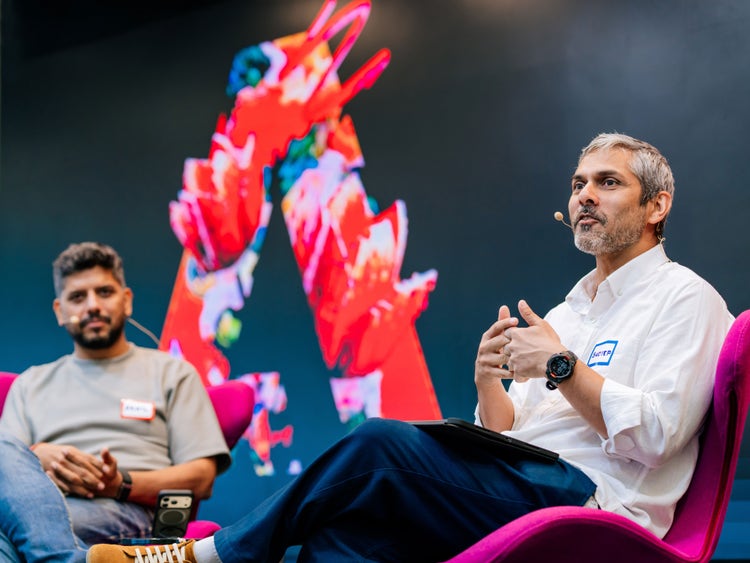
Designers, product managers, and engineers gathered to hear the answer. What appeared was a new way of thinking about roles, relationships, and the fundamental craft of design in an AI-first world.
The shape of product development
The event kicked off with a fireside chat between two Adobe Design leaders, Akhil Chugh (Senior Director, Product Management, Document Cloud) and Sudeep Chaudhuri (Director, Product Design, Document Cloud), discussing how design roles are adapting to the changing product development process.
The conversation centered on the strongest shape in nature: a triangle. One side is users, a broad spectrum of people with diverse needs and workflows. Another is the product. At the base are the people doing the building, confronting genuinely open questions about how the product development process is changing.
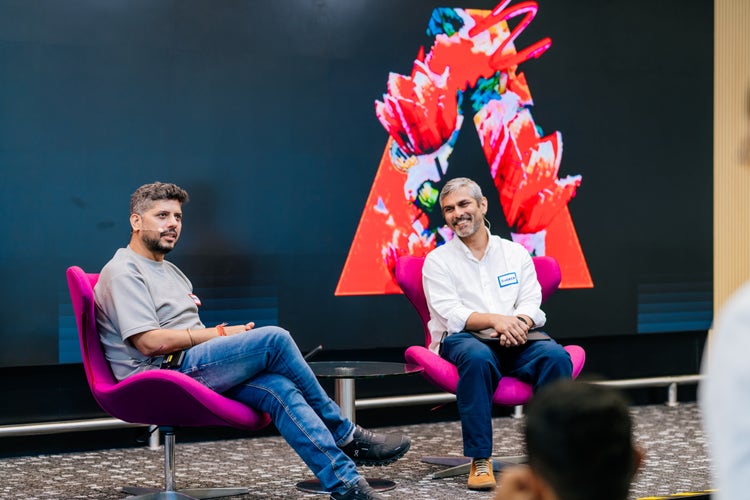
Each side exerts pressure: what users need shapes the product; the product shapes how teams work; and how teams work shapes what they're able to build. No single side can dominate without destabilizing the whole. That geometry, Akhil argued, describes how the product development process puts new pressure on collaboration—when any one aspect weakens, the entire process becomes unstable.
Roles are blurring
With the softening of boundaries for traditional roles, there’s both tension and opportunity. Suddenly, product managers are coming into conversations with wireframes, designers are pushing requests into live products, and engineers are making UX calls in real time.
Sudeep reached for a cricket analogy: We’ve moved from test matches to T20 (Twenty20, a shorter, faster-paced version of the game). The urgency is real. As roles become more fluid, everyone will be expected to contribute beyond their traditional lane. But that doesn’t mean specialization disappears. “I’m still expecting my lead bowler to bowl,” he said. The point is that everyone needs to understand a little more about what their teammates do.
What anchors this fluidity is trust built through questions, not despite them. A PM questioning a design decision isn’t an attack on expertise; it’s the mechanism through which understanding deepens. The more questions that are asked, the more trust is developed among the team because the non-negotiables don’t change: understand the customer problem, question why a solution is the right one, and resist the urge to chase any idea without first understanding whether it’s worth pursuing.
You can’t wireframe behavior
AI isn’t just blurring the lines between roles. It’s also forcing design solutions beyond traditional human-computer interactions. With the introduction of agentic AI, designers must suddenly craft three-prong experiences—between humans, interfaces, and models—that disrupt old design processes.
Roshinth Sreekumar (Senior Product Design Manager, Adobe Acrobat) described a pivotal moment while designing an agentic Acrobat feature where AI clocks a user’s intent and acts on it before being asked. The question the team found itself stuck on was tone. When an agent is proactive, should it sound confident? Celebratory? How should it respond when it gets something wrong? These weren’t questions you could answer in a spec or surface through a workshop with sticky notes because they only existed once the product was alive.
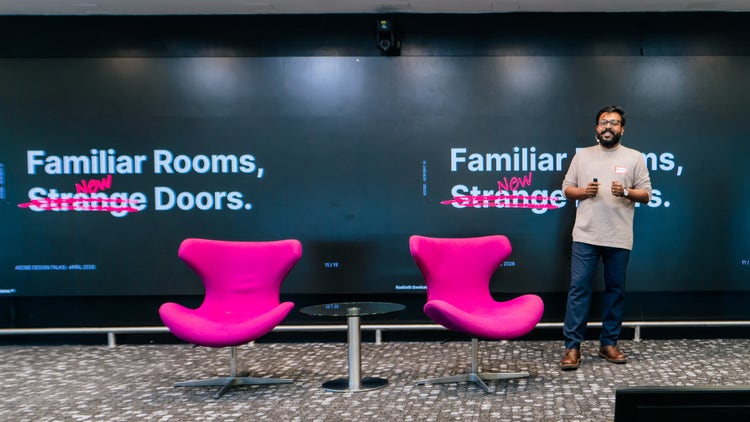
The team’s response was to build rough, early, and together—not to ship quickly, but to generate the right questions. Design, product management, and engineering in the same room, using AI tools to make invisible problems visible. In doing this, the process got tighter, but the thinking got broader. Speed created room not to ship faster, but to ask better questions. And that, for Roshinth, is the real discipline... to never stop looking.
From final deliverable to continuous calibration
As the design process expands, so does designer control. With the old human-computer interaction model, the screen was the mediary, and the process was deterministic. But as Taniya Vij (Senior Product Design Manager, Adobe Illustrator) noted, designing for AI breaks that deterministic process.
A prompt might generate three different outputs, so there is no final state to design toward because the product keeps shifting and evolving. Agents keep making new decisions, and instances appear that nobody ever designed for. That shift is from screen design to behavior design, from journey flows to system design, and from static outputs to ongoing calibration.
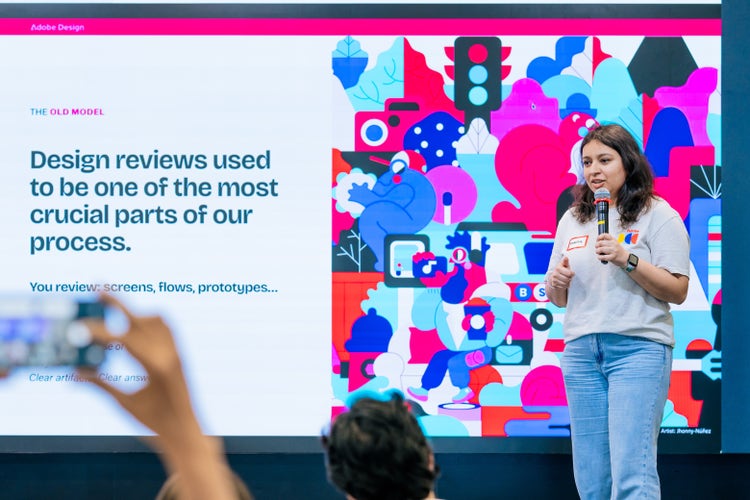
Design artifacts are no longer the final deliverable. Instead, there’s continuous calibration. For Taniya’s team, that means building quality evaluation frameworks, reviewing model responses for bias and tone, and co-creating with engineering from the earliest stages of discovery.
Velocity, not just speed
The excitement around AI-assisted building is real: Designers are pushing product requirements, product managers are vibe-coding interaction, and feature backlogs are shrinking. But the risks are real, too. Who’s thinking across features, holding product coherence together, and ensuring business logic is baked in?
For Abhishek Majumder (Group Product Design Manager, Adobe Express), the answer isn’t to slow down, but to move with velocity rather than speed. That distinction, borrowed from physics, is the difference between how fast a team is moving (speed) and how fast a team is moving in a particular direction (velocity). Velocity, in a product development context, requires that design, product, and engineering move together.
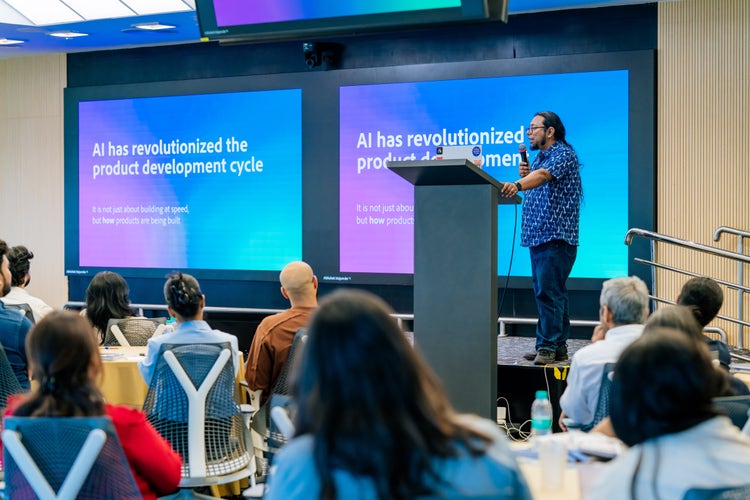
He used the Snake Boat Races (a fast-paced canoe race in Kerala, India) to clarify his reframe: The winner isn’t the crew rowing most furiously, but the one moving in perfect synchronicity. Guardrails—whether agents that check for organizational rules, design systems that live in markdown files within codebases, or small cross-functional teams that evaluate features against what already exists in a product before merging—are what make that coordination possible in product development.
What doesn’t change
As the product development landscape reshapes, the importance of fundamentals becomes increasingly clear. The tools are new. The pace is new. The artifacts are changing shape. But the core work of design—judgement, craft, building for customer needs, and fostering trust with the people you’re working alongside—isn’t going anywhere.
Akhil put it best near the end of the fireside chat: Whatever form AI takes in our product development process, those principles that were true 20 years ago will continue to be true. And that might be the most useful thing to take from a day spent talking about change because it means that the ground beneath the acceleration is stable.
About Adobe Design Talks
Adobe Design Talks is a series of learning and networking events for creative professionals that foster connections, community, and conversations on the role and practice of design in technology.