At the edge of discomfort
AI is changing our work and, as our roles evolve, it’s shining a light on our skills
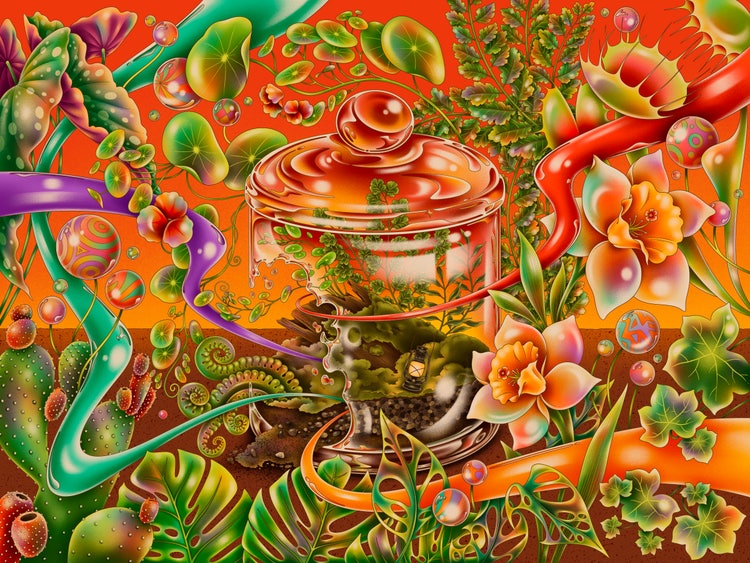
We’ve spent our careers defining ourselves by what we do. Designer. Researcher. Writer. Engineer. Many of us have built our identities around those titles. They describe our roles, but they don’t describe what we know how to do. Beneath them are years of skills we’ve built. We ask questions, make connections, solve problems, understand people, make decisions, and know when something doesn’t feel right.
Those skills aren’t tied to a role, a title, or even a discipline. They can travel with us, evolve, and show up in ways that we haven't even considered yet.
Becoming comfortable with feeling uncomfortable
Imagine you’re standing in a dark room, holding a lamp that lets you see only what’s immediately in front of you. Suddenly, someone flips on a floodlight. You’re overwhelmed and blinded by the light, slightly disoriented as your eyes adjust. As your surroundings come into view, you realize you’re in a room that extends far beyond what you thought. Details start to catch your eye; you notice doors you’d overlooked and corners of the room you didn’t know were there.
That’s how I feel about the time we’re in right now: Our eyes are starting to adjust to the light, and we’re starting to see all the possibilities in front of us. Artificial intelligence might be changing the jobs we know, but what if the things we're afraid of losing aren’t actually the most important? Our value lies in the skills, judgment, perspective, and care that we’ve developed through our work. We carry those qualities forward as our roles evolve.
In his essay “The Job-Shaped Reality Distortion Field,” Paul Millerd discusses how artificial intelligence is warping our relationship with work by reducing it to salaries and job descriptions. That conversation often overlooks the reasons many people love their work. We work for money, of course, but also for purpose, self-worth, challenge, and belonging. Work lets us practice what we’re good at, get better at what we care about, contribute to something larger than ourselves, and gain recognition for our knowledge. A job provides the structure for all of that, but it isn’t necessarily what gives work meaning. When we conflate the two, we risk assuming that a machine, that can perform someof our work, can replace everything our work represented.
At its core, work is applying human effort, attention, and care to change something in the world. The skills we bring to it are what we know and practice. Our skills don’t just make us capable of doing the work in front of us; they expand what we can see, imagine, and do next. We’re being asked now to hand over some of those tasks to machines, and there are many tasks that those machines are incredibly good at:
- Processing information at extraordinary speed
- Synthesizing and cross-referencing data
- Recognizing and surfacing patterns
- Automating repetitive work
What we must be careful about is equating artificial intelligence with "knowledge." Data and tasks are the domain of artificial intelligence. Information (that we provide) gives those things context, but knowledge is an inherently human combination of information, experience, observation, culture, and opinions about how the world is unfolding around us. Knowledge leads to judgement—knowing what to do with knowledge in a particular situation.
Machine learning excels at revealing patterns from what happened in the past—even if that “past” is only milliseconds old. Humans do something different. We don't function based only on what’s happened in the past; we experience what is happening now. We observe (and process) cultural shifts, social dynamics, political moments, contradictions, and emotions that may never be captured as data. Humans don’t absorb experiences or the world around us objectively. Our perspective and what we know are continuously shaped by who we are, what we’ve experienced, and how we interpret the world around us.
Our reactions, emotions, and “feelings” can spark greater creativity, help us look more closely, or push us to go deeper. But we don’t just interpret the world around us; we decide what to do about it. We have agency. We can decide that a “rule” no longer serves a situation and choose not to follow it. Machines can break rules too, but only within conditions that people have created for them; their “rule-breaking” still operates within a specific set of parameters.
So, let machines do what they’re extraordinarily good at, and let's stop trying so hard to put a name to our work, our titles, and our output. We are bigger than our titles, bigger than our disciplines, and bigger than what we produce. Let's define ourselves by what we can do, the skills we’ve built, what we notice, the questions we ask, the connections we make, and how we choose to apply them.
Our jobs are going to continue to change. It’s time to become comfortable feeling uncomfortable with those changes. There’s something freeing about reaching the edge of what you know and realizing you don’t have to stay there. At the edge of that discomfort, we can freeze, we can pause, or we can stop and decide not to go forward. It's also where we can learn to fly.