Beyond productivity: Designing space for creativity
How rest, joy, and attention fuel creative work
Creativity isn’t born from production pressure; it's born from play and wonder. And it doesn’t die from laziness; it dies from overload. Everything built and automated begins with the human brain. Even the AI systems transforming our work are created from human knowledge, imagination, and ingenuity. But when a nervous system is overtaxed, overworked, and overstimulated, output degrades.
I've spent my career inside high-performing, high-output teams. I’ve also helped build them in leadership roles at Spotify, Walmart Labs, InVision, Fandango, and now at Adobe. We talk constantly about optimizing performance and scaling output, but we don’t talk nearly enough about protecting the conditions that allow people to do original, imaginative work. Instead of asking ourselves how we can be more productive, we need to begin talking about how we can protect the systems that allow our creativity to flourish.
The science of overload: What happens to creativity when our brains are tired
Creativity depends on the health of the system that allows it to thrive. When the operator degrades, output does too. How your brain works, how your nervous system supports it, and how both influence original thinking matter more than we often realize. Creativity relies on the interaction of three brain networks:
- Executive attention: Helps with focus, planning, and turning ideas into action.
- Default mode: Often called the imagination network, it's active during walks, showers, daydreams, and other quiet moments.
- Salience: Helps with notice of what's meaningful, novel, or worth paying attention to.
Insights emerge across all three networks. But in our ultra-connected, always-on world, all are strained by a steady stream of social and digital interruptions competing for our attention. What does that overload look like in practice? Research from Microsoft’s Human Factors Lab found that people in back-to-back meetings showed different brain activity than when they had five- to ten-minute breaks between meetings. The people were the same. The meetings were the same. The difference was an opportunity to pause and reset.
The takeaway is summed up in the title of the report: “Research Proves Your Brain Needs Breaks.”
A framework for protecting creativity: Reset, Spark, Protect
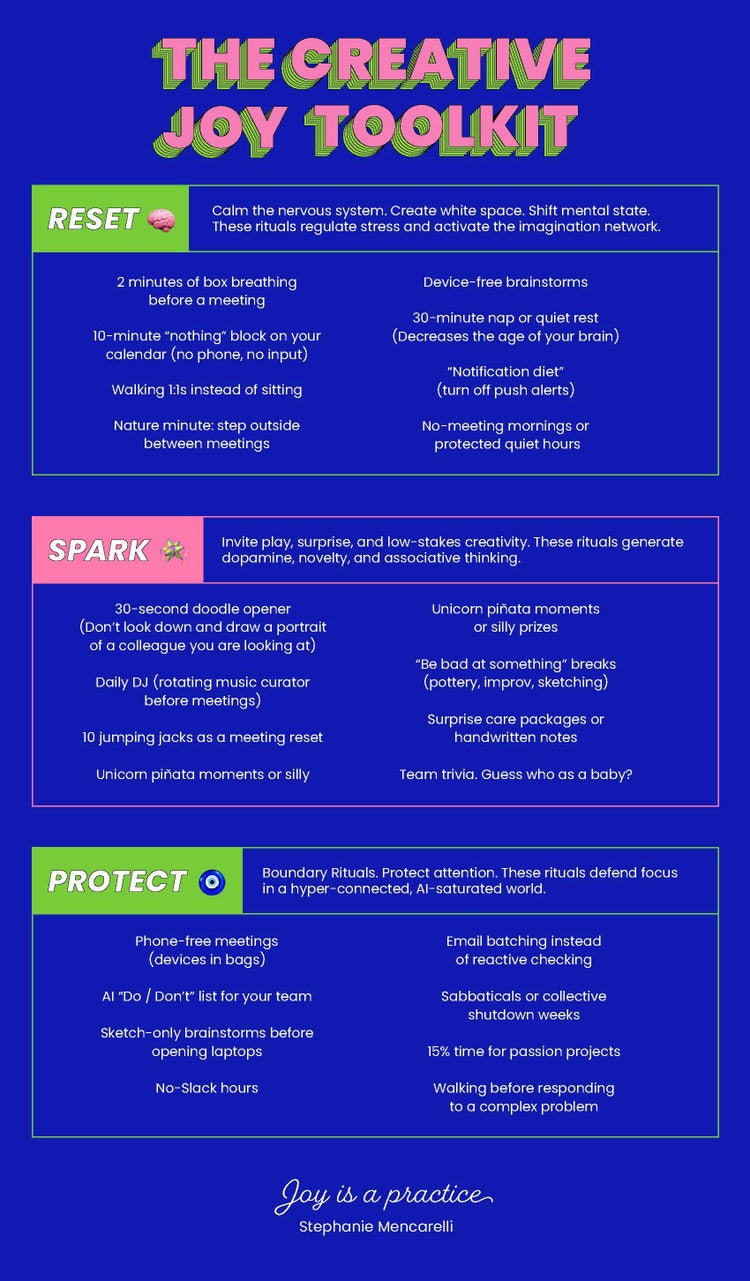
Creativity requires that people regularly reset their nervous system, spark joy through play and surprise, and protect their attention by setting boundaries with technology. It’s not always easy to know where to start, but small changes can have an outsized impact.
Reset: Take breaks

Breaks lasting 20 to 30 minutes allow the prefrontal cortex, the brain's planning and decision-making center, to recover. Rest isn't the opposite of work; it's part of creative work. Without the white space that breaks provide, our brains can't create; they can only react. Before smartphones and tablets, boredom was a normal part of daily life. Today, many people rarely experience distraction-free time.
Movement changes cognition. A Stanford study found that creative output increases by 60% when walking compared with sitting. Albert Einstein famously walked with colleagues, and most people can probably relate: Our best ideas rarely arrive while we’re staring at an inbox. It’s one reason I use a treadmill desk during team meetings and design reviews; it keeps my brain primed, engaged, and focused on what’s being presented. It’s also why I take my dogs for a walk during lunch on most days. Anyone who's had an afternoon meeting with me after I've skipped that walk can probably tell the difference. And because visiting unfamiliar places and intentionally disrupting routine can help spark fresh thinking, I often take different routes. The next time you're stuck at your desk, remember that even small interventions between meetings (five or ten squats or a few minutes turning away from the screen) can help your brain reset.
Nature offers a similar reset. Research at the University of Delaware found that patients recover faster when they can see trees and green space from their hospital rooms. Time outdoors can restore attention, encourage new thoughts, and help us process ideas in ways that built environments can't. Incorporating nature into a daily routine doesn't need to be complicated: Every morning, I walk outside and stand barefoot on the lawn while brushing my teeth. It's a small, unusual ritual, but it helps me start the day grounded and present.
For some people, sleeping provides the break they need: I recently chatted with a well-known Chief Design Officer, and they take naps every afternoon, almost every day. That seems improbable, but 20–30 minutes of napping improves memory, mood, and alertness. Naps are not lazy. They’re neurological maintenance. A study at University College London found that habitual nappers had larger total brain volume—equivalent to being two to six years younger.
Not everyone can take a walk, a nap, or spend time outdoors during the workday. But almost everyone can pause for a minute and breathe. Box breathing—four equal counts of inhaling, holding, exhaling, and holding again—is a technique often used in high-stress environments. Deep breathing calms the nervous system and creates the cognitive flexibility that supports creative thinking.
Spark: Design creative space

Shemaiah Gonzalez's Undaunted Joy: The Revolutionary Act of Cultivating Delight taught me that joy isn't denial, it's fuel. She argues that choosing joy in the face of suffering is an act of rebellion, a response to darkness rather than an escape from it. Joy is also deeply connected to attention and presence, both of which are constantly challenged by our modern distraction culture.
But joy is not a personality trait. It’s not luck. It’s not “some teams just have good vibes.” Joy is designed. It’s intentional. So how do we “put our oxygen masks on first” and cultivate joy? As leaders, we can do things that aren’t related to productivity, so our brains (and the brains of the people on our teams) get the boosts of dopamine they need for the cognitive flexibility required in the creative process.
I recently started a large team meeting with a photo of water. If I can help my team feel more present, relaxed, and open to joy, even for a few minutes, the effects are surprisingly lasting. It's important for all of us to consider how we might help someone around us—friends, family, colleagues—even if it's something as simple as reminding someone to unclench their jaw or take a deep breath.
Working at Spotify's Stockholm headquarters introduced me to a different relationship with rest. At first, coming from American hustle culture, the amount of vacation time felt unfamiliar and uncomfortable. But I came to see how seriously people treated recovery and how much it contributed to their creativity. I saw firsthand the impact of time off, and my US-based colleagues now benefit from it because I push my team to take more time away from work. It's not just because I want to be a cool boss; it's because I know that when they return, they’ll be more creative.
To help with those essential extended breaks, Adobe has a program that gives employees paid sabbatical leave every five years (the duration increases over time from four weeks to six). We also have two week-long shutdowns each year (one in the summer and one in the winter), and a handful of Global Wellbeing Days. When everyone takes time off at the same time, even people who have horrible work boundaries are forced to rest because no one is around to respond.
I know that many of the ways to make room for creativity in the workplace are out of our control, so I want to end with something we can all do for ourselves: One of the most powerful ways to create space for joy is to give yourself permission to be a beginner again. Trying new things, and being bad at them, builds creative courage. I liken it to the Japanese art of kintsugi (repairing broken pottery with gold lacquer): You can be bad at something, you can break something, then you can repair it with gold, and it becomes more beautiful than before.
Protect: Set boundaries with technology

Because creativity and imagination are human, I have this saying: “You won't be replaced by AI, but you might be replaced by someone who knows when not to use it.” Use AI like a calculator, not like a composer. Let it clear away the work that isn't worthy of your creative brain then step away from it so you can focus on the work only humans can do: making something new.
Turn off as many of the notifications on your phone and your computer as possible. Research from Florida State University showed that simply seeing a notification, even without touching your phone, creates the same cognitive distraction as actively using it. When you’re with people, try leaving your phone off the table. Prime your brain, and the brains of the people around you, to be present in the moment. I was talking to another design leader recently about just this topic and they said, “Well, you can do that because you're the boss.” I vehemently disagreed; everyone can do it and still be a responsive colleague. I'm still online, I'm still at work, but I’m no longer allowing constant alerts to dictate my attention. I recommend it often to the people on my team.
And the distractions don’t stop at work; we live primed for distraction in our personal lives too. Concerts should be joy epicenters. Yet many of us experience them through a screen, holding up our phones to capture moments we'll probably never watch again. Instead of immersing ourselves in someone else's creativity, we're often distracted with documenting it.
I'm not suggesting we fear technology, but we do need to design boundaries for it. Distraction scales, but so does presence. When we create space between ourselves and the constant pull of technology, we give our minds time to reflect, imagine, and create.
The most valuable technology
Everything built begins with a human mind. Yet many of us spend our time safeguarding our productivity more carefully than our creativity. But creativity doesn't flourish when we push harder. It flourishes when we create conditions that allow it to thrive.
Taking breaks, choosing joy, and setting boundaries are not indulgences. They're maintenance for the most valuable technology we have: the human one.