Understanding why people embrace, avoid, or struggle with AI in creative workflows
Conversations about AI adoption often focus on the people using the tools. We ask why some people embrace AI while others resist it, and simultaneously assume the differences come down to curiosity, enthusiasm, skill, or confidence.
But in my work studying AI adoption in enterprise tools, I kept seeing examples that didn't fit those explanations. Some of the people most eager to use AI couldn't; they had access to everything they needed but still weren't moving forward. I began trying to understand that contradiction: If AI in creative tools is available to everyone at the same time, why isn't adoption more linear?
What emerged from my research is that AI adoption in creative enterprise tools has never been just about products or features. It’s shaped by user psychology, organizational constraints, regulatory realities, and behavioral patterns that exist well outside a feature set. What I learned about large organizations is also broadly applicable to all creative work and can give creative professionals some insights into why AI adoption isn’t always as straightforward as it seems like it should be.
The questions that changed my thinking
People absolutely experience excitement, anxiety, uncertainty about change, and attachment to existing workflows. But those explanations didn't fully account for what I was seeing. Some highly motivated people still couldn't adopt AI. As my research progressed, I came to think of adoption as two separate, but related, questions: Can someone start using AI at all? And if they can, how far can they go? I referred to those conditions as readiness and maturity.
- Readiness reflects the conditions that make adoption possible. In enterprise settings, those conditions might include access to the right tools, governance policies, infrastructure, permissions, data availability, or organizational support. A person may be eager to use AI, but if those conditions aren't in place, adoption can stall before it begins.
- Maturity reflects what happens once that door is open. It encompasses skill, trust, training, workflow integration, and experience. Some people are just beginning to experiment with AI, while others have already woven it deeply into their creative practice.
What I came to understand is that readiness works like a gate. It isn’t one influence among many that gradually tip someone toward adoption; it’s a threshold. Below a certain point, the conditions just aren’t there, and skill and motivation can’t compensate for their lack. Someone can be capable and genuinely eager and still find themselves on the wrong side of the line. It's only once those conditions are met that the question becomes how far they can progress with the technology.
Readiness and maturity aren’t equal at every stage. Early on, readiness is what matters, because it decides whether someone can begin at all. Once the conditions are in place, though, it fades into the background, and maturity takes over to shape the experience. The question shifts from whether someone can even use AI to how well they can use it and how deeply it fits into their workflow. The conditions come first, and skills build from there.
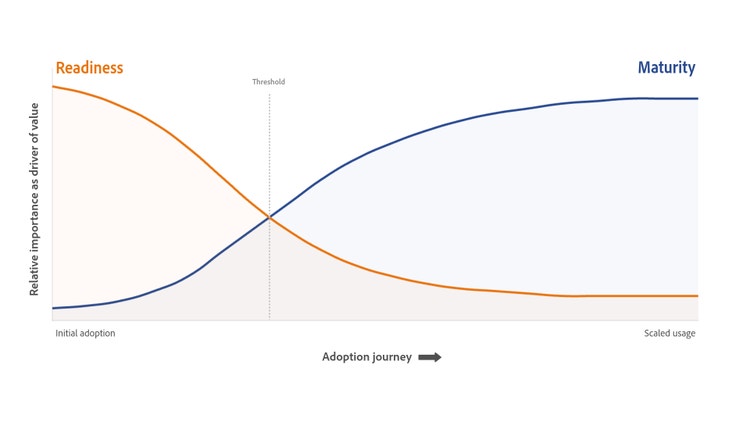
A crucial realization was that readiness and maturity are related, but not interchangeable. Someone can have the skills and motivation to use AI and still be blocked by circumstances. Another person may have access to everything they need but is still figuring out how AI fits into their workflow. That distinction helped explain something I'd been observing: Creative people often appear to be responding to the same technology in dramatically different ways.
Why creative people have radically different experiences with AI
One creative professional is using AI every day; a second is experimenting cautiously; another wants to use it but faces restrictions; and a fourth doesn't even see a compelling use case yet. We often assume that these differences in AI adoption reflect differences in attitude, ability, curiosity, or enthusiasm. But my research suggests that AI adoption reflects differences in circumstances; every creative professional is operating under a different set of circumstances that shape how and when they incorporate AI in their work.
- Empowered: People or teams with high readiness and high maturity. The environment supports AI use, and they have the skills, confidence, and workflow understanding to benefit from it.
- Intimidated: People or teams with high readiness but lower maturity. They have access and enabling conditions but may need education, simpler interaction, clearer guardrails, onboarding, supported interaction, or progressive trust-building.
- Frustrated: These users have low readiness and high maturity. They are highly motivated, with the skills and desire to use AI, but still unable to adopt it because they’re blocked by access, policy, infrastructure, compliance, or disconnected asset systems.
- Disengaged: These users have both low readiness and low maturity. They’re stuck at the start and don’t possess the enabling conditions or the desire to adopt AI as part of their creative workflow.
Because the archetypes are situational rather than fixed, they’re nuanced and flexible. A creative person might be Empowered in one AI workflow, Intimidated in another, and Frustrated in a workplace context where tools are restricted. The important point is that each reflects a different combination of readiness and maturity. People who appear similar on the surface may be facing entirely different barriers.
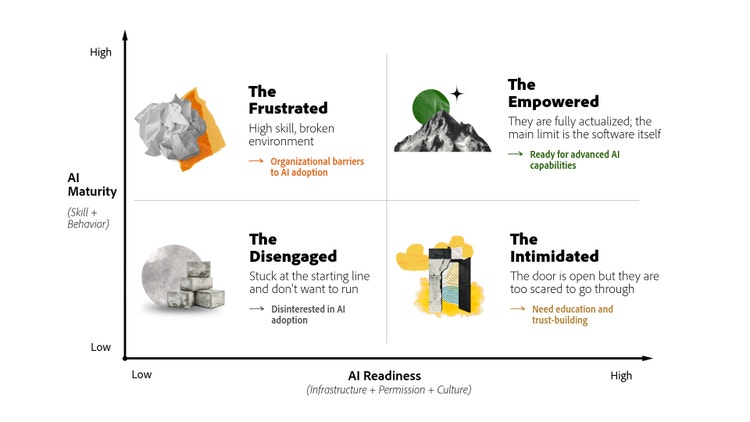
Viewing AI adoption through this lens, rather than pinning it on individual attitudes toward technology, can help resolve adoption hurdles. The Intimidated don’t need more access; they need education, clear guardrails, and time to build trust. The Frustrated need the barriers around adoption removed. Better onboarding does little for someone who can’t get through the door, and opening the door does little for someone who’s already inside but unsure where to start. By distinguishing between readiness and maturity, it’s easier to see and understand trouble spots.
AI adoption is not a singular challenge. People are often perceived to be standing at the same starting line, but the reality is that they are not. Before we ask how skilled someone is, or how far they can go, we may need to ask whether the conditions exist for them to begin at all.
Research: "Beyond the Feature Set: Two Frameworks for Enterprise AI Adoption," by Reem Mehdoui, March 2026, ADRS EPGr