Rethinking creativity in the digital era
A conversation between Adobe researcher Laura Herman and experimental musician Holly Herndon
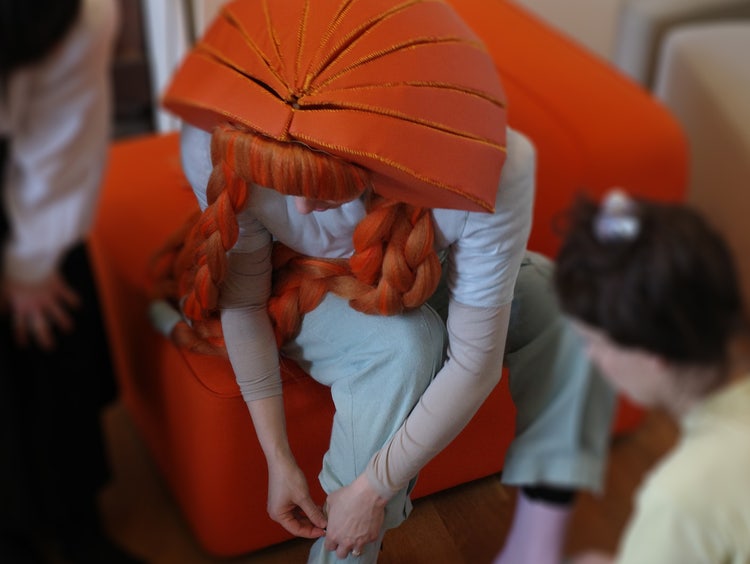
Holly’s work, exhibited at institutions including the Whitney Museum of American Art, Serpentine Galleries, and MASS MoCA, blends experimental electronic music, machine intelligence, and questions of identity, collaboration, and agency.
She and Laura Herman—who leads AI research for Adobe's creative tools and serves as a curator of digital art at the Victoria & Albert Museum—discuss collaboration, consent, public participation, and how emerging technologies are reshaping creative practice.
Laura Herman: What do you say to creators who are hesitant to try this new technology?
Holly Herndon: There isn’t one blanket response. I take the stance that it's one of the most consequential technologies of our time, and worth getting familiar with. Even if these systems aren't ones you want to incorporate into your practice, it's good to understand how they work and what they mean. Much of the reporting on this subject has been inaccurate or misleading. I encourage engagement, which can take many forms. I make my own models; my own training sets. I see every step as a creative intervention.
Even with productized AI, it’s worth understanding how they work so you can have an informed opinion. I started working with AI over a decade ago and had to build from the ground up. It forced me to answer big questions earlier because we were creating our own data sets. No one ever said, "Don't put other people's music in your training set." It just felt wrong given my background in music. I'm grateful we started so long ago, as it helped shape our approach.
Laura: With so much funding and attention going into AI, how have you seen the community and the work change? Do you think that's been beneficial, or has it deteriorated the quality?
Holly: It's both. It's "here comes everybody,” and in some ways, it’s amazing because it means you have more perspectives, backgrounds, and specialties. But it also coincided with a prevalence, a tendency, toward a “culture war-ification” of every topic. “My team says it's bad, so I'm going to jump on the bad train, etc.” Many interesting nuances were lost.
Laura: Do you see any new artistic practices or genres emerging in response to generative AI?
Holly: A lot of experimentation happens in secret because it’s been so polarizing. We're going to see interesting things trickling out. It’s been surprising to some that much of our work focuses on bringing people together in public spaces. That deals with AI and how collaboration is changing.
Laura: In your project, The Call, you worked with community-contributed voice data from across England. How did you think about agency in those contexts, and your own agency as an artist?
Holly: The Call, then subsequently Star Mirror, was about inviting the public to train choral AI models based off regional folk traditions. It was important that it spoke to the local context. One of the reasons we chose to work with choirs is that they provide a nice metaphor to view the potential of AI as greater than the sum of its parts. It's a collaborative effort that couldn't exist without its contributors but becomes entirely new when gathered. Our tagline was “let's find a beautiful way to make AI.”
It involved a laborious process of communicating across choirs. We even piloted a data trust model in which everyone voted on the use of their recordings. That was an experiment to understand what the public might want from AI. What kind of permissions or consent mechanisms could work? It turns out, people don't want to think about microdetails or the different use cases of their data, but they like being asked.
We ended up putting most recordings into the public domain and making this available to everyone. We’d been thinking about the commons we can all draw from, and the role of intellectual property (IP), as it’s this important yet outdated structure that doesn't work for the AI era. In some cases, it protects artists; in others, it protects the largest companies and locks smaller organizations out of experimentation with consequential tools. We need new ways of thinking. The cleanest option we came up with was the public domain.
Our organization Spawning, with Jordan Meyer, assembled the largest public-domain image dataset used by developers to train models. We're looking into creating a diffusion model from just public-domain images. This would be useful for artists who haven’t wanted to engage with generative AI because of IP concerns. You can also create a fine-tune on your work and see that model as your own creation that hasn't infringed on the IP of anyone else.
Going into communities that weren't actively involved in AI and piloting this project, it was interesting to understand where anxieties lay. People who post music or videos online are already training models, but don't think about it. It was a giant public service announcement.
Laura: As an artist, when you're working across systems, community groups, and participants, how do you maintain your artistic identity?
Holly: There's a wholeness to everything I do, an essence or context. I've collaborated with my partner, Matt Dryhurst, for over a decade, and I’ve learned that the work is most important, and the ego comes second. I find the role we're in feels like that of directors, working with specialists. If we're all providing a clear vision and are creative in the areas where we excel, we end up with a better product.
That's one thing AI is great at: with many models, these are collective training sets. Combining the output of a choir with my own music archive to create a mutant model enables collaboration with vast numbers of people in ways that weren’t possible before. It’s been described as having an “alien collaborator,” but I see it as being able to aggregate and organize human collaborators.
Laura: With your own work, where does the art itself reside? Is that the output of the system or the system itself, the social process, the training dataset, and the models?
Holly: We describe our art as protocol art, meaning we set the rules for a project, and then the media or objects are downstream of that logic. We're able to do things we couldn't even dream of ten years ago. We work with performance, recording, installation, and sculpture. Not because we're polymaths, but because we're designing these systems. It has some similarities to conceptual art or Fluxus. It's an updated version that recognizes today's tools and how networks work.
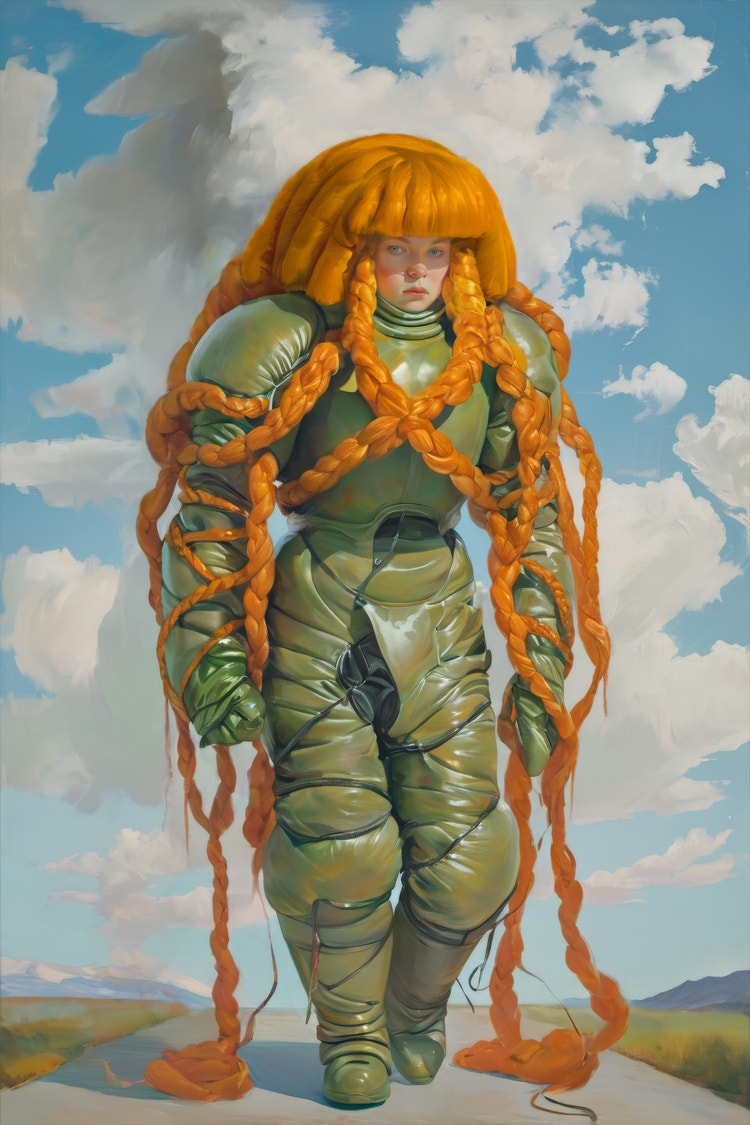
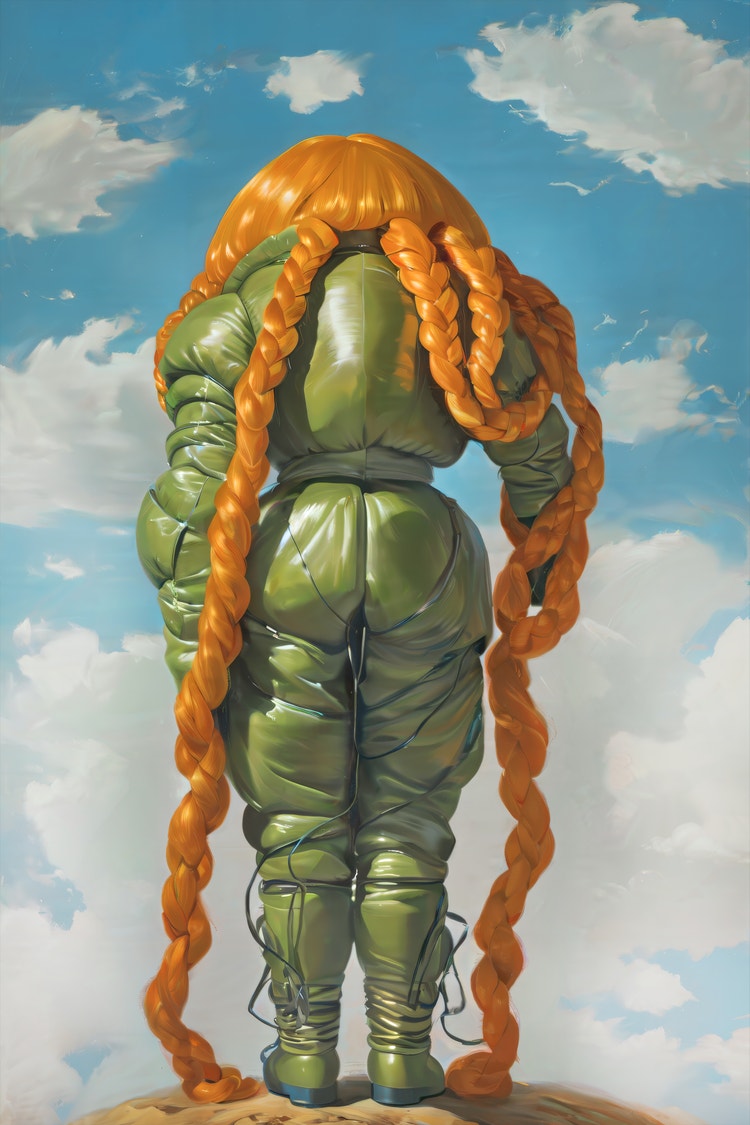
It's an entirely new proposition to set up a system and then allow anyone to play with it. The series we made for the Whitney, "xhairymutantx," is a model that played with this idea of “data poisoning.” I have an embedding in most public models because there are enough images of me online to meet a certain threshold. There's a concept and embedding of “Holly” in latent space. I'm not a fully fleshed human; I’m just a redheaded generic blob. Whereas, if you're super famous, you're HD.
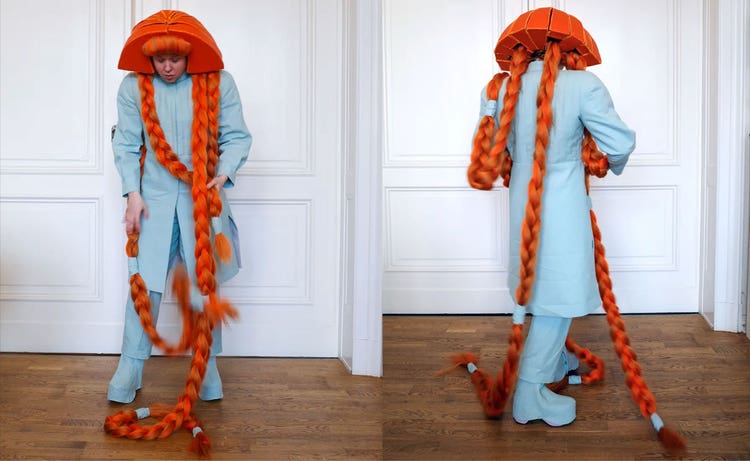
We thought it would be fun to play with that, and created a superhero character with giant red hair, by leaning into embedding pastiches and pictures. We made a model, invited the public to prompt through that model, and made even more images of this Holly monster/Gollum, infecting every image with an X-ray mutant X-ness. Those images have flooded the Internet and become a public embedding space.
Laura: Are there moments where the systems surprise you? Or, do you feel because you're controlling the protocol, it’s actually quite predictable, and the surprise comes from humans?
Holly: Surprise comes from everywhere. It's easy to talk about these systems as one thing, but there are many different architectures. Anytime we're trying something new, I'm surprised in one way or another. My background is in computer music, and one thing that computer musicians love is the element of surprise: the history of algorithmic, systems-based compositions where you set it, audition it with your ears, hear something wild, and then take those highlights and present them to the listener. I'm always delighted when something goes wrong.
Laura: When we first started experimenting with generative AI tools at Adobe, our VP of Design said, "This is the one time when users will laugh when we get something wrong instead of being frustrated." Now expectations are heightened, but it’s still a kind of wonder.
Holly: Exactly. It depends on what you're working on. When you're noodling or experimenting, it’s just delightful to be surprised.
Laura: There’s a conversation around voice as the new interface for AI tools, and a focus on synthetic voice as a future direction for artworks. I'm curious about what you think about your voice and whether you see it as an interface, a tool, an artifact, or a part of your identity?
Holly: It's all of those. I've worked with voice for 20 years and still find it interesting. It's full of contradictions and inflection points. A voice is a communal organ you share. You learn through mimesis—your accent, and your language—from the people around you. Then you perform your voice as an individual through that shared organ. The voice has always been a site for contradictions. It’s an inflection point to think about community and individuality.
Laura: The idea of being able to spill into different artistic mediums because of these new technological affordances. How do these systems unlock new forms of creativity?
Holly: We value people with expertise when we collaborate. It allows us to sketch and ideate in different modalities that would've been prohibitively slow, since we would have had to learn a new software and start the object from scratch. You can sketch, ideate quickly and powerfully, and communicate with those who have greater expertise. With fabrication, we can test different methods by generating scenarios, and then those go out into the real world, and become something entirely different through craftsmanship. It broadens the toolkit.
Laura: With your work around dataset creation and model tuning, what responsibilities do you feel different groups might have, whether it's the technologists building the tools or the artists using them?
Holly: We often think about data manners. “Treat someone as you would like to be trained on.” I don't like to be too dogmatic because I don't know if the choices I make are the right choices for someone else. But I do think we could have some standardized "digital manners” towards how we handle each other's digital likeness and data.
Laura: Are there examples of solutions you want to share for using AI speed runs in development?
Holly: Many of our art practices are based around this. Holly+, my digital twin, was imagining how people would deal with allowing others to perform as their own digital twin in a consensual way. We launched the Have I Been Trained platform, where people could check whether their imagery was appearing in training sets. And we developed SourcePlus as a way to opt out of training with a simple API.
There have been many solutions, but they require either government enforcement or widespread adoption. But relying on how things worked in the past isn't going to work now. We must rethink how we deal with each other's creative output and how a creative community can thrive. That's going to require input, compromise, and listening. I would like to see more people come up with workable solutions.
You can now use regular language to develop software (one of the most important mediums of our day) that was previously unavailable. This is going to be life changing; we're trying to think through what that means for a contemporary art studio. We're not trying to have a bunch of automated art bots making art for us. It's about using these systems to complement our workflow and collaboration and organizing so we can communicate better and build an interesting store of context as an ongoing archive of our thought process.
Laura: What questions still feel unresolved or urgent?
Holly: There are questions about the social contract. Technology is going to dramatically change people's workflows and social lives. We need to think about what that means and how we interact with each other.
I'd like to see the digital town squares healthier. Our media information diets are unhealthy, and it may seem counterintuitive that AI could help with that, but there is a world in which AI could play a role in improving them. Many of the fears and criticisms of generative AI are criticisms of the contemporary Internet and of how creative practices do not flourish in an attention economy.
People hear generative AI and think of what we have now, but ten times worse. I don't think it has to be that way. We can design an alternative. The future of AI isn’t fixed. It’s something we’re actively shaping—and that requires participation, compromise, and imagination.