Taste over haste
Why in an era of automation, nurturing creative vision matters more than ever
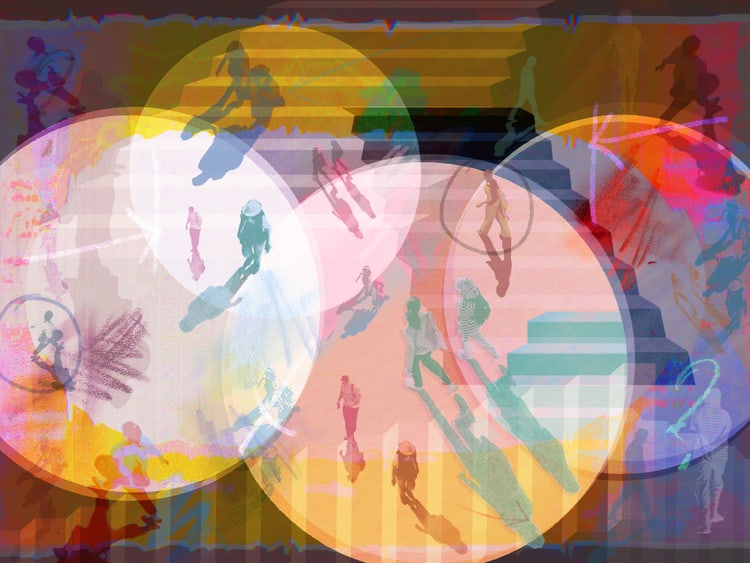
Taste is a sensibility born of experience, a synthesis of one’s education, geography, politics, personal triumphs, and traumas. It's a reflex, an inclination, an internal standards filter that allows one to discern the good from the merely good enough.
While championing taste—or “good taste,” to be specific—has always been implicit in a designer's role, it has arguably become more pronounced in the age of AI. Awash in an ocean of ready-made possibilities, the best designers distinguish themselves by knowing exactly which ideas are worth pursuing and honing. As sociologist Pierre Bourdieu puts it, "Taste classifies, and it classifies the classifier."
Democratizing taste
Taste is a loaded topic, and the idea of good taste remains stubbornly entangled with elitism. It tends to conjure images of aristocrats pondering the patina of their escritoire, sommeliers swirling Sauvignons, or critics peering down from high balconies. In Distinction: A Social Critique of the Judgement of Taste, Bourdieu identified one's social position and early upbringing as the sources of taste. He argued that our dispositions, what he called habitus, are so deeply internalized as to feel inescapable.
Yet in practice, taste has proven to be more fluid—weirder, more democratic, and harder to pin. Now, educators and practitioners immersed in AI are increasingly questioning bygone clichés and reframing taste as something more intentional than inherited. Greater access to eclectic forms of intelligence could finally loosen the determinism of habitus. Curiosity, that most human impulse, remains a currency available to all, no password required.
"Nobody owns taste," contends Orlando F. Ruiz, a creative director and WeTransfer's former vice president of creative, whose current obsessions include vibe coding, which he deployed to build his first app. He cites Todd Solondz's 2016 dark comedy Wiener-Dog, and Divine, the bawdy, larger-than-life star of John Waters' movies like Hairspray, Pink Flamingos, and Mondo Trasho, to illustrate the elasticity of taste. “Is it tasteful? Probably not. Is there taste? Absolutely,” he argues. “Taste feels more to me like having a point of view and committing to it fully—attitude, voice," explains Ruiz. It's worth noting that in an essay about taste, he’s invoking a drag queen who purportedly ate actual dog feces on camera for the sake of art. Divine committed, and that's the point.
"Very often, what we call 'good taste' reflects social conditioning rather than any pure aesthetic truth," says Marta Handenawer, co-director of the Master in Applied AI for Arts and Design program at the Elisava School of Design and Engineering. "For me, it's more about coherence and intention, and working with AI makes this especially visible."
Handenawer, who is also the creative and research director at the Barcelona-based design studio Domestic Data Streamers, points out that certain aesthetics dominate most AI-generated imagery, referring to the glossy, stock-photography-like schlock that’s been described as "visual elevator music." It takes both technical skill and critical awareness to push past them, she explains. In this sense, taste in AI-assisted design becomes less about picking what looks cool and more about retaining creative agency over the result.
For Handenawer, that sometimes means actively resisting the system's push toward perfectibility. "Creatives are constantly losing access to earlier, more imperfect but sometimes more interesting versions of these models," she says, recalling the unpredicable results outputs from early versions of DALL·E. "What if that imperfection is precisely what makes it artistically meaningful? Why should we always be moving toward smoother, more 'perfect' images?"
A similar tension plays out among sound engineers and musicians who lament the rise of AI remastering services programmed to smooth out the crackle, hiss, and noise of recordings. Brian Eno observed how quickly listeners develop an affection for the textures initially considered flaws; often, the moment newer technology erases them. "CD distortion, the jitteriness of digital video, the sound of 8-bit, all of these will be cherished and emulated as soon as they can be avoided," he writes in A Year with Swollen Appendices. “It's the sound of failure: So much modern art is the sound of things going out of control, of a medium pushing its limits and breaking apart."
Distinguishing between creation and production is useful here. Automated systems are remarkably good at accelerating execution, but far less capable of originating novel ideas on their own. "In the era of ‘I shipped this in five minutes,’ you cannot really survive without an educated point of view," explains Ruiz. When AI handles the grunt work, the designer's irreducible contribution becomes judgment—knowing not just how to make something, but whether it is worth making, and why.
And what happens when taste takes a backseat to AI?
Toys "R" Us learned this the hard way when it debuted a brand film generated with OpenAI's Sora at the Cannes Lions advertising festival in 2024. The segment depicted Charles Lazarus, the company's late founder, as a boy dreaming of a toy empire that would bear his name, a concept that suggested warmth and wonder. Tech glitches aside (see the case of the missing freckles), some critics dismissed the production as "soulless AI slop." For them, Toys "R" Us committed a cardinal sin of creativity. They didn't produce anything particularly good or spectacularly bad; it settled squarely in the most unforgivable territory of all: the mid.
The school of good taste
The most intrepid designers treat cultivating taste as a lifelong endeavor—a kind of continuing education with an ever-expanding, ever-shifting curriculum. They develop a Renaissance attitude about learning across subjects, even those that may not seem directly relevant to their current projects.
Developing taste means learning how to think and work in two directions: deeply and broadly. It involves diving into rabbit holes in search of novel references while maintaining a pulse on the broader societal context in which their work operates. Beyond knowing how to assemble the right mélange of fonts, clever puns, and arresting imagery, good taste requires designers to bring their full faculties to bear.
In fact, two influential thinkers on the matter of taste suggest how our bodies can foster this education. French gastronome Jean-Anthelme Brillat-Savarin, the Ur-foodie behind the oft-cited 1825 treatise The Physiology of Taste; Or, Transcendental Gastronomy, identified the mouth as the portal for human vitality and pleasure. Japanese philosopher Yanagi Sōetsu suggested that good taste is nurtured through the hands. Writing a century later in The Beauty of Everyday Things, he argued that the manual toil and quiet focus involved in craft work result in a kind of inalienable embodied design intelligence.
Handenawer too underscores the unseen labor involved in sharpening one's sensibilities. "Forms of labor such as research, framing questions, building trust, and navigating ambiguity remain undervalued because they are difficult to quantify, yet they are essential to any meaningful creative outcome," she says.
Ruiz, who is known to give his team copies of Bruno Munari's manifesto Design as Art, also emphasizes the importance of inquiry in the design process. "It's about asking: Is it meaningful? Is it believable? Is it interesting?" It's also about trusting the moment when something clicks, when emotion and intellect align, he says. And it never quite settles. "I do not know if good taste is a talent you are born with, but once you think you have it figured out, it is time to start questioning things again," Ruiz says. "The goal is always on the move."
Ultimately, this intellectual restlessness may be the most reliable path to taste—and to career longevity, precisely because good taste is fugitive. When AI can generate polished solutions at scale, a discerning designer’s edge lies in knowing when something isn’t quite right and caring enough to keep pushing until it is.