The practice
What Giorgia Lupi has learned on the yoga mat and at the painting table shapes her work
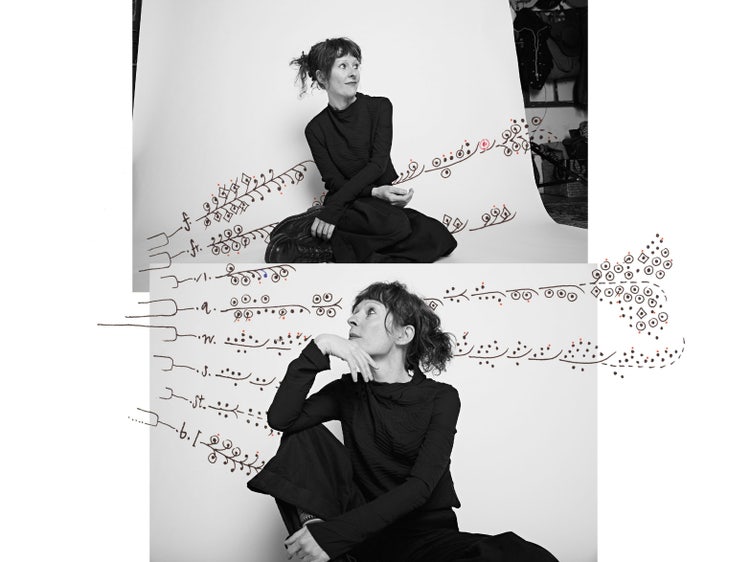
We move through our series in silence while the teacher walks between the mats, assisting individually. Some of the shapes are, frankly, absurd—bending backward to catch your own heels, face toward your feet, which the body would, very reasonably, prefer not to do. Or folding into lotus with your arms threaded, rocking in a circle on your own spine and, on a packed morning, rolling onto your neighbor’s mat. Anyone watching would be within their rights to ask, “Why?” But there is no skipping ahead: The posture you want, which the teacher gives you only when you’re ready, lies beyond all the ones you’d rather avoid. The only way is through, each pose preparing you for the next.
No one who has practiced long enough believes the postures are the point. Through them, I’ve become aware of my body to the millimeter. Yoga lets me feel the smallest change from one morning to the next: how much I slept, what I ate, whether I argued with the one I love. Nothing hides on the mat. I’m competitive, but this may be the one place where competition gets me nowhere. Some mornings a posture simply doesn’t open, and the only thing that works is to stop demanding it—to soften my shoulders, lengthen my breath, and stay with what is there.
On the mat, I always know what comes next. But in my painting studio, where I do the work that sustains me creatively, I almost never do. I sit down with paints and a blank canvas—or a large sheet of paper—and let my hands guide me. Not knowing used to be the thing I could tolerate least. A blank canvas meant accepting that I didn’t know what was coming. But the disaster I expected never arrived. Instead, what emerges usually surprises me, often changing my mind about what I even wanted in the first place.
At Pentagram, where I lead a team of designers, what I’ve learned on the mat and at the painting table shapes my work. Whether designing an identity, an exhibition, or a data visualization, I can hold a brief open and unresolved far longer than I could ten years ago, without forcing an answer before its time. Like many, I now have AI tools within reach. You write a brief, a half-baked idea, a question you’re not even sure you care about, and a result appears, sometimes before you’ve finished typing. A prompt takes four seconds. A backbend takes four years. Today, the two can fit into the same workday.
But used without introspection, these tools often remove the discomfort of sitting with a question you cannot yet answer. The mat taught me to trust the process—and myself. A posture that looks impossible isn’t reached by force, but by returning to it again and again, calmly, over hundreds of mornings. You enter the difficult shape on purpose, stay for five long breaths, and leave changed only by accumulation. My years on the mat live in the way I breathe, how my nervous system settles. My years of drawing live in my hand, in what my eye notices before my conscious mind catches up. What happens when we skip the process?
When people worry about AI usurping human-made creative work, they often focus on the quality of the outputs. What interests me more is what the making makes us. The mat is where it’s impossible to confuse practice with result. Even if nothing is produced at the end of the hour, I am who I am outside that room because of what happens inside it. Those afternoons at the studio made the paintings, but they also made the person who painted them. For years I judged them by what they produced. Only recently have I understood they were producing me, too... Even if nothing is produced at the end of the hour, I am who I am outside that room because of what happens inside it. Those afternoons at the studio made the paintings, but they also made the person who painted them. For years I judged them by what they produced. Only recently have I understood they were producing me, too.
So, if a result can arrive without anyone having practiced, who do we become if we spend our lives making things and none of the making makes us? In this new era, I don’t worry that we’ll stop creating. I worry that we’ll stop being changed by the process. Perhaps the question isn’t what AI can make, but what we’ll keep practicing when it can make so much for us. Will we still return, notice, change? I believe it’s something we will have to protect, even when nothing, and no one, requires it anymore. But no technology can decide whether we keep showing up. That part is still ours.