What shapes design: Insights from Adobe Design Summit 2026
How quality, judgment, and craft will continue to define creative work
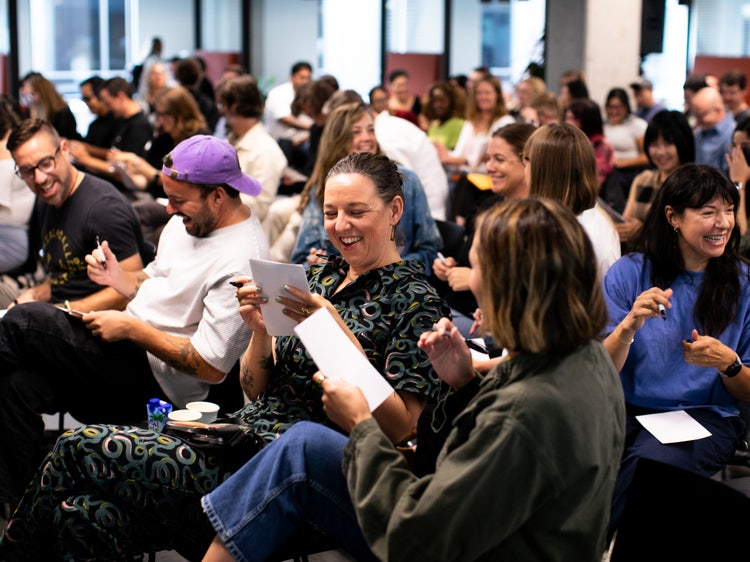
It was a topic that surfaced repeatedly throughout Adobe Design Summit 2026, an annual gathering of Adobe's global design organization and its creative partners. Each year, Design Summit creates space to reflect on values, priorities, and the craft behind Adobe's products.
Over two days, speakers explored this year's theme, Reimagine, and invited everyone to question assumptions, see with fresh eyes, and find the spark that ignites their work. Underlying many of the talks was a common question: What type of future do we want to enable?
Grounding design in deep understanding
Eric Snowden (SVP of Design, Adobe) framed Adobe's future around a simple but enduring principle, "The best ideas aren't just clever. They're not just about technology. They're grounded in a deep understanding of what the people we're creating for need."
Looking back at Adobe's history, from PostScript to Illustrator, Eric highlighted a pattern that’s defined design for decades: questioning assumptions, understanding how people work, and building tools that make difficult tasks feel possible. Great products emerge from that deep understanding of customer needs.
In a world where AI makes it easier for anyone to build anything, design’s opportunity is to solve meaningful problems—and quality, judgment, and customer empathy are its greatest differentiators.
Community raises the standard for creative work
Grounding in human understanding extends to the communities designers build together. In a wide-ranging conversation, Eric Snowden and Resh Sidhu (VP of Creative, Adobe Studio) explored what design leadership looks like during a period in which AI dominates conversations. Their vision for creative community is one where creatives help each other navigate change, share knowledge across disciplines, and collectively raise the standard for work.
The conversation returned repeatedly to people, teams, and community rather than technology. It challenged a growing focus on volume, "It's not that you need to make more. You need to stop and ask: ‘Why are we making it’ and ‘Who are we doing it for?’” Generating content is no longer a differentiator; taste, conviction, and the ability to create meaningful work are.
The future belongs to students of craft
Raising the standard of work begins with a personal relationship to craft. Elliot Coakley (Senior Director of Design, Adobe.com) described a career built on curiosity, craft, and a relentless commitment to improving his skills. It was a personal reflection on the role that passion and continuous learning play in creative careers, and how great work is powered by countless invisible hours of exploration and iteration.
Whether the challenge is print design, motion graphics, prototyping, or AI, growth comes from curiosity and a willingness to learn: "Every time a new tool comes out, are you comfortable being a beginner again; are you willing to start over?”
For Elliot, the future belongs to creators who remain passionate students of their craft (learning, obsessing over details, experimenting) while using emerging technologies to extend their abilities rather than replace them. Tools can remove friction and accelerate workflows, but they aren’t a substitute for years of accumulated creative decision-making.
Design inherits more than it invents
Growth is bigger than any one career. Jennifer Rittner (Assistant Professor of Strategic Design and Management, Parsons School of Design) used shadow as a metaphor to explore how creative knowledge, craft, and technology are passed from one generation to the next. Drawing on philosophy, history, design, anthropology, and personal experience, her talk centered on how everything we create carries traces of what came before it: Creative work isn’t the product of isolated genius but of accumulated knowledge and shared traditions that stretch across cultures and centuries.
Through examples ranging from ancient artifacts and lace-making traditions to books, fashion, and design education, she spoke of how ideas evolve while retaining connections to their origins. Creative influence, whether visible or not, extends to the work of countless future creators; and designers have a responsibility to teach, enable, and support those future generations. By doing so, they become part of an ongoing lineage of creativity, "Your creative DNA is encoded in the work of people you will never meet."
Designing for connection and belonging
By drawing on sociology, mythology, anthropology, and his experience building the DesignUp community, Jay Dutta (VP, Adobe Design India) turned toward how people form connections, develop shared identity, and create meaning together. He examined the deep human need for belonging and our ability to develop communities around shared values and fulfillment through two engines of belonging: affiliation through association (sports fandom) and belonging through shared experiences and collective purpose (creative communities).
Jay challenged designers to think of themselves as curators and stewards of shared spaces where people can connect: “People want to come together. They want to belong. But communities rarely emerge without effort.”
Authenticity is more powerful than perfection
Adam J. Kurtz (Artist and Author) delivered a candid and humorous reflection on creativity, vulnerability, and connection while exploring the role of honesty “as the most important element in creating work that connects with others." He described his creative practice as a process of publicly working through personal experiences, anxieties, and emotions.
Many of Adam’s projects began as personal experiments, jokes, or emotional responses before unexpectedly resonating with wider audiences. But rather than striving for polish or expertise, he embraces imperfection, directness, and authenticity—which are more powerful when the goal is to move people. Success and achievement evolve over time, but worth is defined by a creator’s ability to be vulnerable and connect through shared human experiences.
As technology continues to affect and change creative work, questions about how to design the future will continue to arise. The conversations at Adobe Design Summit 2026 suggest that craft, connection, and quality will remain part of the answer.