Where are we meeting now?
In a post-pandemic, remote-work era, how are creatives rebuilding community IRL
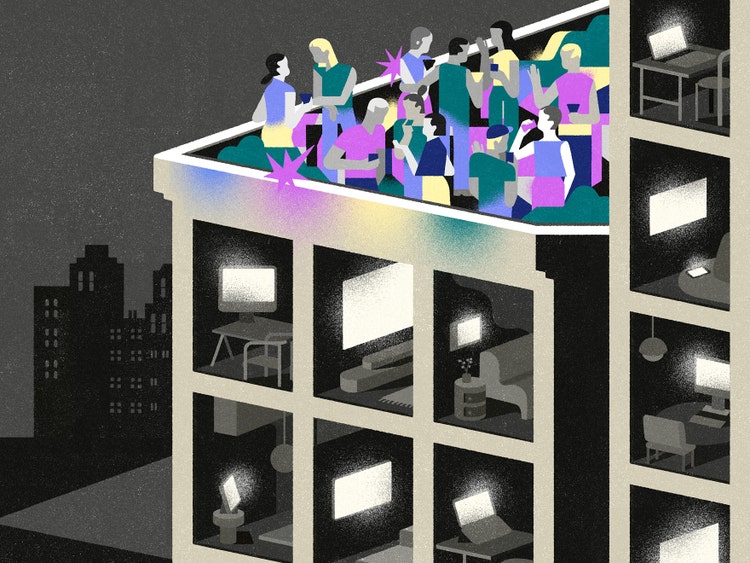
Between the pandemic, the popularity of remote and hybrid work, and the rise of developing technologies, the pace of change over the past few years has felt dizzying. We’re living more of our lives virtually than ever, catching up with friends via social media instead of over coffee, meeting with colleagues on Zoom instead of conference rooms, and turning to generative AI and productivity apps for help instead of assistants. This has led to an extremely online culture:
The average person spends, according to Pew Research, 6.5 hours a day on a screen, with 41% of adults and teens saying they’re online almost constantly.
But there’s an understanding that while it’s easier than ever to stay connected, it can’t be a replacement for in-person interactions, which has led to ripple effects IRL: There’s a craving for more impactful, specific, and personal experiences in person that offer a deeper level of connection—to your community, your work, your colleagues—that you can’t get anywhere else.
It’s especially true for people in creative fields who depend on close collaboration. Many spaces that existed to bring the like-minded together in the same room have either closed—such as The Wing, which convened ambitious women, and NeueHouse, which was tailored for creative professionals—or scaled down significantly, like WeWork.
The next generation of spaces is becoming more niche and localized. There’s Brooklyn’s Newlab, an application-only innovation hub designed to attract start-ups, which has expanded to Montevideo, Detroit, New Orleans, and Riyadh since its 2016 opening. Social club-type venues like WSA, in Manhattan, and SAA, in Brooklyn—both overseen by Happier People MGMT, creative director Gabriella Khalil’s hospitality brand—have become places for the it-crowd to mingle. This fall, James O’Reilly, one of NeueHouse’s cofounders, and his business partner, restaurateur Adam Elzer, launched Lore, a bathing club they hope members will visit as often as the gym.
The spaces that matter now aren’t necessarily the biggest or flashiest; they’re the ones that foster depth,” says Jenny Nguyen, founder of Hello Human, a New York–based public relations consultancy focused on helping emerging design and architecture studios grow their businesses. In September, Nguyen opened Hello Human House, an office and gallery for members of Hello Human’s network who previously convened at events and attended talks. “We’ve seen that trust and loyalty built in-person far outpace what you get from broad but shallow digital interactions,” Nguyen says. “In the age of AI, nothing cuts through like a face-to-face relationship.”
Jennifer June, a furniture designer and maker based in Hudson, New York, is launching a new kitchen collection at Hello Human House this fall and is excited by the prospect of more personal, slower connections. “There’s storytelling and pulling back the curtain of ‘this is how it’s made,’ which may not come through in a beautiful website image or on Instagram,” June says. Plus, the feedback is more useful than a “like” comment. “I find it helpful to hear other people’s reactions. Even just to see where their hands go, what they grab, what they reach for—the body language in it is really interesting.”
Anand Sheth, an architect based in San Francisco, recently opened a pop-up in the city’s Mission District that channels a similar desire for more personal interactions. He and his collaborator, Anand Upender of York Street Collective, envisioned a new type of hospitality-focused third space for the neighborhood, where Sheth has lived for 15 years. Aptly named Storefront Anand Sheth, the pop-up features a concept shop and gallery alongside Upender’s craft mocktail bar and morning cafe. For the space, Sheth built a custom bar modeled after a residential kitchen and curated an exhibition of design objects and sculptures by friends and West Coast-based studios he admires.
The space feels more like a home than a stuffy white-box gallery, and Sheth encourages visitors to come and hang out, with no obligation to buy anything. For the pop-up, which closes at the end of December, Sheth and Upender are organizing free poetry readings, comedy shows, lectures, and curator tours of the exhibition by appointment. “This opportunity to be less conventional helps to encourage connection,” Sheth says, “you’re going to meet more people at a house party than at a restaurant or bar, so we’re borrowing cues.”
Bringing people together is at the heart of executive director Michael Diaz-Griffith’s work at the Design Leadership Network (DLN), a professional organization for principals of design firms. “The fact is, whether you’re young or old, rich or just starting, cool or terribly uncool, we all face the same challenges, and having peers in the room to discuss them can make or break someone’s practice,” he says.
Today, the DLN convenes both virtually and in person. To determine programming, Diaz-Griffith considers the trade-offs between time and what members will gain from gathering. He has mostly continued Zoom meetings post-pandemic for when receiving timely clarity is more important than in-person alchemy (like when new tariffs were instituted that affected DLN’s members). He also recently began hosting DLN’s summits, which have over 300 participants, in international cities rather than hotel ballrooms, like conventional conferences. They’re structured as insider tours, featuring studio sessions, visits to private art collections, and dinners with notable chefs, with the next one scheduled for this fall in Madrid.
By spending time together while sharing new experiences, the DLN believes members can forge stronger connections, feel creatively nourished, and become more empowered as business leaders. “In the pandemic, we were all seduced by this idea that, wow, maybe everything can happen on the screen. And a lot can, but it never gives the feeling of buoyancy and connection that an in-person encounter does,” Diaz-Griffith says. “But being mindful about what we say yes to is increasingly important when we’re being offered so many opportunities to be out there.”
That more of us are glued to our screens is also changing how community itself is made virtually, which is then reflected in in-person gatherings. Two years ago, Emilia Petrarca, a fashion journalist, launched her Substack newsletter, Shop Rat, to cover trends she saw with her own eyes, rather than what was going viral online. “I launched with a simple idea,” she says, “I just wanted to leave my apartment and go outside and visit stores.”
Part of Petrarca’s vision was to get readers offline and visit the places she did, too. Eventually, she began hosting events for subscribers, starting with a first anniversary party held at the Brooklyn boutique Outline, which included readings from her favorite authors. “It’s nice to be able to see people in person and understand who the heck is reading my newsletter,” Petrarca says of these events. She’s noticed a similar reaction among attendees too. “People want to be a part of a community, and I’m always amazed and encouraged by the fact that they will show up alone and start talking to the person next to them and make friends,” she says. In September, Petrarca celebrated the second anniversary of Shop Rat with a summit on the state of fashion at the Manhattan outpost of French department store Printemps. The event sold out in 30 minutes.
As the cultural terrain continues to shift, we’re all still finding our footing and discovering new hangouts. What better reason to log off and meet each other—or someone new—there?