Celebrating analog in a digital world
The quiet resurgence of making things by hand
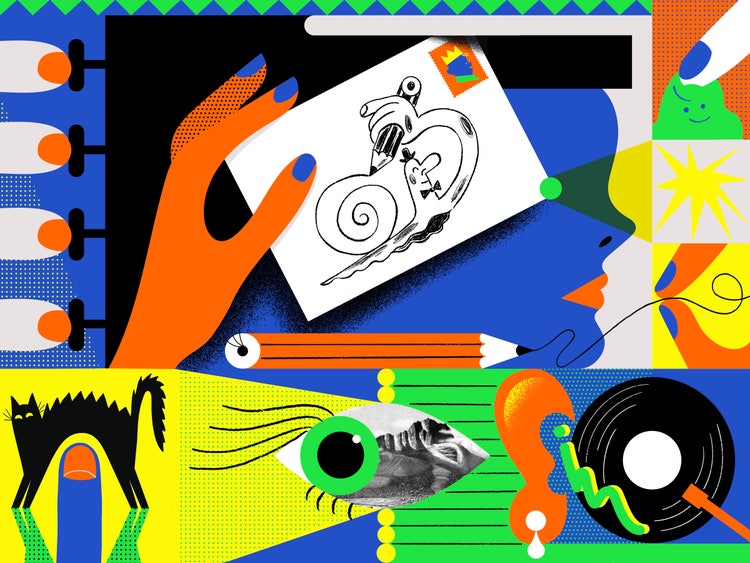
Muting the visual cacophony—a riot of graffiti, sagging clotheslines, droopy houseplants, the slinky alley cat—proved more challenging than expected. Contending with the clumsiness of my QWERTY keyboard-conditioned hands was humbling. How does one operate a pencil again? At the day’s end, I went home with two things: an anemic rendering of some stone archways and a blazing appreciation for old-school ways of making—a sensibility that’s stayed since.
My seemingly random detour into drawing is hardly random. History suggests a familiar pattern: During periods of technological upheaval, slow, tactile media reliably undergo a renaissance. In 2016, for instance, when the Internet of Things, self-driving cars, and 3D printing dominated headlines, vinyl records flew off shelves in the UK, and Lomography cameras were deemed cool again. That same year, Canadian journalist David Sax published Revenge of the Analog, a lively chronicle about how “dead technologies get repositioned for new life.” Sax argued that the revival of analog wasn’t a rejection of digital technology, but a reconsideration of an expanded toolset for human creativity. “Sometimes analog simply outperforms digital as the best solution,” Sax wrote.
This pattern persists during the age of artificial intelligence. It’s not entirely surprising that California amended its education code in 2024 and reinstated cursive penmanship in its mandatory curricula, believing that kids who learn to swipe before they scribble might benefit from learning to loop letters legibly. The proliferation of woodworking shops in Silicon Valley and the renewed interest in obsolete machines, such as typewriters, landline phones, Blu-ray disc players, and cassette decks, all point to the same impulse.
As AI becomes more powerful and pervasive, the desire for a hands-on counterpoint feels more acute and more personal. Unlike the sledgehammer-wielding Luddites of the Industrial Revolution or graphic designers who scoffed at desktop publishing in the 1980s, today’s battles aren’t so much with systems but with the self. Faced with technology designed to ape human sensibilities, the existential questions become harder to avoid.
For some creatives, plunging into a personal project offers the time and space to clarify what they value most.
For journalist, author, and educator Rob Walker, it’s about fostering a sense of creative vitality. His wonderful Substack, The Art of Noticing, exemplifies content that can’t be replaced or rushed with AI. Walker explains that AI tools are most useful to him as a research assistant. “I’m less interested in productivity than in making work that lasts,” he explains. “I want each post to be just as valuable and relevant a year or ten years from now as it is the day it was published.” He adds, “If AI turns out to be a way to help with that, I’ll be interested!”
A regular contributor to Fast Company and other media outlets, Walker says publishing his own newsletter has given him a direct channel to thousands of readers—a privilege he doesn’t take lightly. “Showing up in someone’s inbox is kind of intimate. I’ve had moments of overthinking and worrying about what readers will respond to, but I think I’m getting better at trusting my instincts about what will land, even if it’s different,” he says.
Recently, Walker even shared his actual New Orleans mailbox, offering a premium newsletter subscription to anyone who sends him physical mail. “Around 50 to 75 people took me up on it, and it was awesome: postcards, collages, zines, drawings, photos,” Walker says. “It was really inspiring and has got me thinking about doing more with physical mail.”
Similarly, London-based interaction designer Yosuke Ushigome also feels invigorated by the ability to connect with people via physical objects. A volunteer at Repair Cafe Nunhead—a community-run event that’s part of a burgeoning global mending movement—Ushigome tells me that he finds great pleasure in reviving broken turntables, CD decks, and other gadgets people bring in, and hearing the stories behind them.
“I’ve been working on high-level conceptual stuff around technology, products, services, and design,” says Ushigome, who has worked on complex projects for the likes of Google, Sony, and the UK National Health Service. “I volunteer because I want to be hands-on and engaged in what’s happening in our community. On the last Saturday of every month, you can find me in Nunhead, pretending to understand electronics.”
For Holly Catford, art director and co-founder of the celebrated food magazine Pit, the prospect of friendship was a primary motivator for spending her Christmas bonus to fund a new publishing venture. “I really wanted to work with Helen Graves, editor of Pit. We didn’t know each other before, but I loved her writing and her blog, Flavor Nuggets. The running joke is I literally started a magazine so I could be friends with her.”
Catford, whose day job involves navigating tight schedules as art director for several periodicals, including the legendary Eye magazine, says that creating Pit allowed her and her co-founders to experiment with flexible publishing schedules. “When we first started the magazine, Helen, Rob [Billington, the magazine’s lead photographer], and I were in very different places in our careers and had a lot more time to produce issues. Now, we try to do one a year at minimum—we really have to try. If we make too many, we can’t keep up, and it stops being fun.”
Beyond content generation, perhaps it’s the value systems behind AI that come into question in comparison to traditional creative methods. If algorithms promise speed, scale, and bland perfection, more time-consuming tactics are conduits for satisfyingly weird and original thinking—ideas that haven’t been coded in machine learning data sets. At the very least, the slowness of it all buys us time to think—just as that painstaking drawing class slowed me down enough to see differently.